 |
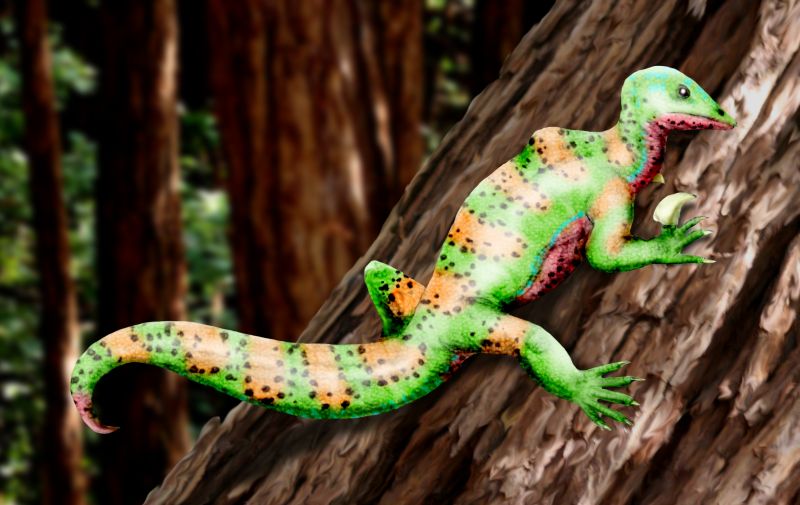
| Drepanosaurus unguicaudatus Image from Wikipedia |
Are you confused by the post title? Good. You should be. If you hadn't seen the image above, you would probably be thinking of some giant chimerical alien monster with pincers, a long, thin nose, a hump on it's back, and the ability to change the colour of its skin to match its surroundings. This is not quite true. The actual animal was probably much less impressive. Probably.
Drepanosaurus unguicaudatus is among the weirdest of the weird. It was a small animal, about half a meter in length. Only one specimen has been found, from Italy. Drepanosaurus has been grouped together with a bunch of similar and only slightly less bizarre reptiles known as the Simiosaurs, which includes weirdos like Megalancosaurus and Hypuronector. Maybe I'll get to those someday. Megalancosaurus is thought to have been a tree-dweller, feeding on insects such as ants and termites, similar to modern-day Tamanduas and Silky Anteaters. Just less fluffy. That explains the Anteater bit. But how about the scorpion?
Drepanosaurus and its close relatives are (not) famous for their tails, which were prehensile and had a mysterious "claw" formed from fused vertebrae at their tips. This claw looked a bit like a scorpion's stinger, but wasn't venomous and was probably used to help anchor the creature to branches. Personally, if I was a Drepanosaur, I'd rather have a poisonous stinger to help fend off annoying predators. But I'm not a Drepanosaur, and its a bit too late to make the suggestion to them.
The Chameleon aspect comes from its habit of climbing trees and its similarity in overall body form. Some of its relatives had opposable toes like a chameleon, too, but Drepanosaurus itself doesn't appear to have had this ability. Instead, it had a horrendously humongous claw that was nearly as big as the rest of the hand. Situated on the second finger, this monstrosity was probably used to rip open ant nests or pry bark off trees to get at the tasty beetle grubs. Or you could argue it was used between rival males to whack each other until one backed down. Whichever you prefer.
The head wasn't found with the fossil, but if it's close relative Megalancosaurus was anything to go by it was uncannily bird-like, with large eyes and a pointy, crow-like beak. It sat on the end of a long, skinny neck. And this is where the "camel" bit comes it. Directly above the animal's shoulders the vertebrae rose up in a tall bump. This was probably a muscle attachment point, allowing the reptile with its long neck to dart its head out and capture insects faster than the bugs could see. All very well, but it would have made the animal look something like the Hunchback of Notre Dame. Except it was Italian. Hmmm... The Hunchback of St. Peter's Basilica?
 |
| The forearm of Drepanosaurus, minus the fingers. A and B are the humerus in side and front view. U is the ulna. R is the radius. MCI through MCV are the metacarpals in order. UL is the Ulnare, which is one of the hand bones. D is the whole lower arm intop view, |
Last, but very definitely not least, we come to the animal's forearm. The forearm has more weirdness per cubic centimeter than any other aspect of the animal. It was quite clearly specialized for some pretty bizarre muscle attachment, meaning it was probably extremely strong, but it's just so strange that it boggles my mind. The Ulna is nearly at a right angle to the Radius, bones which are parallel in nearly every other animal that has them. It is flat, curves a bit back toward the hand, and is extremely wide, almost square. The ulnare, one of the hand bones, acts as a kind of replacement for the supremely specialized Ulna, being elongated and running mostly alongside the Radius. I have no idea what it was using such a preposterous arrangement for. Maybe it was a shield to keep it from whacking it's funny bone.
So yeah, that's Drepanosaurus. It's weird. Its a Scorpion Camel Anteater Chameleon from Neptune (Sorry, Italy.) And it's woefully underrated. NOBODY knows about it, and those that do are paleo-freaks like me. Which means there are very, very few decent pictures of it, which means this post is a little bit threadbare. Fortunately there are other, equally weird animals out there who are a little less camera-shy.
Until next time.
